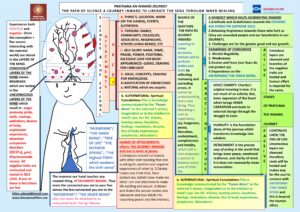
Conscious and the Unconscious layers of the mind
Modern psychology, broadly speaking, classifies the human mind or psyche (PSUCHE) into two categories: the Conscience and the Unconscious mind. Affirmation begins in a mother’s womb (some psychologists would place it in the formation prior to the womb, to the intention of the parents before the conjugal act).
Modern psychology also speaks about how the child in the womb is affected by the emotions of the mother picking up the signals from the surroundings. Imagine if the external voice itself would excite and affect the child, how much more do mother’s emotions! Hence, when we are born, we already have a bright side and a dark side; fears, anxieties, shocks and traumas. As we grow up, we again pick up good/ pleasant and unpleasant things from the society, things contrary to our values that are stored up in the conscious layers of the mind. Underlying all these, writers also speak of the effects of negative traits. Pride, jealousy, anger, avarice, sloth, gluttony and cravings.
Every human being is born with the presence of “ANTAR YAMI” “THE TREE OF LIFE” / within the deepest center of the SOUL which is also “THE DEEPEST POINT” is “THE HIGHEST POINT” “AWAKENING” the sixth sense , THE INNER BEING in the deep.
“THE DEEPEST POINT” is “THE HIGHEST POINT” “AWAKENING” the sixth sense also helps to perfect the five senses. The function of “ANTAR YAMI” “THE TREE OF LIFE” is to differentiate between the various reports of the senses in order to lead us towards transformation- the way we perceive ourselves and others.
This is a PATH is about JOURNEYING INWARDS at your pace. It is about being truly alone with “ANTAR YAMI” “THE INNER BEING” WITHIN resting in “THE SILENCE OF THE QUIETUDE” with a selfless intent/without any agenda, through the practice of Love, Humility and Detachment in our thoughts, words and deeds.
And there comes a time when the person begins to JOURNEY INWARDS with the help of is “ANTAR YAMI”, “THE INNER BEING” through the conscious and later through the unconscious layers of the human mind decluttering it or cleansing it stage by stage. Thus begins the Inner Healing of the person.
For instance – The traditional narrative about Abhimanyu in the womb is often interpreted to illustrate the concepts of conscious and unconscious learning, though the Hindu epics themselves do not explicitly use modern psychological terms [1].
- Conscious Learning: Abhimanyu consciously absorbed the knowledge about how to enter the Chakravyuh while his mother, Subhadra, was awake and attentively listening to Lord Krishna’s explanation [1]. This suggests active, conscious reception of information.
- Unconscious Block: Subhadra fell asleep during the explanation of how to exit the formation, causing a break in the transmission of information [1]. This interruption meant Abhimanyu did not consciously or unconsciously learn the exit strategy.
- Result: The information was stored incompletely [1]. During the Kurukshetra war, Abhimanyu was able to breach the Chakravyuh based on the knowledge he “consciously” acquired in the womb, but his lack of “unconscious” access to the exit method ultimately led to his downfall within the formation.
In a modern psychological context, some interpret this story as an example of prenatal learning, suggesting that even in the womb, a child’s subconscious mind is receptive to external stimuli and information, which can later influence conscious actions and limitations [1]. The interruption of the story while Subhadra slept highlights the idea that the learning process was dependent on the mother’s state of awareness, impacting what the child could ultimately access.